

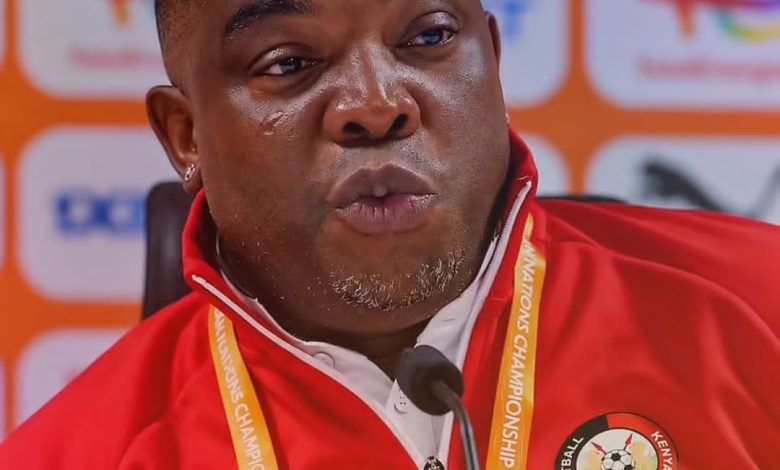
As Harambee Stars head to Guinea, the coach’s record, his approach to the local game and a string of off-field issues are raising uncomfortable questions
When Benni McCarthy was unveiled as Harambee Stars head coach in March 2025, there was genuine excitement around the national team.
Here was a former Bafana Bafana star, Champions League winner and a former Manchester United coach taking charge of Kenya. His reputation suggested that he would bring a different level of tactical thinking, discipline and professionalism to a team that had struggled for consistency for years.
But 20 matches into his tenure, the excitement is beginning to give way to questions.
Did Football Kenya Federation get the appointment right?
That question is particularly relevant now as Harambee Stars travel to Conakry to face Guinea in an important AFCON 2027 qualifier.
The answer should not be based on McCarthy’s reputation as a player or his time at Manchester United. It should be based on what he has done with Kenya.
And on that front, the numbers are difficult to ignore.
The numbers tell their own story
McCarthy has presided over 20 matches since taking charge.
Kenya have won eight, drawn five and lost seven.
They have scored 33 goals and conceded 33.
That gives McCarthy a 40 per cent win rate and an average of 1.45 points per match.
There have been good results, particularly during CHAN.
But after 20 matches, Harambee Stars still have no positive goal difference under McCarthy.
Thirty-three goals scored.
Thirty-three conceded.
For a coach brought in to prepare Kenya for AFCON 2027, including a tournament Kenya will co-host, that record deserves a serious examination.
The Senegal night that will not go away
The biggest stain on McCarthy’s record remains the 8–0 defeat to Senegal.
Kenya were completely overwhelmed that night, conceding five goals inside the opening 30 minutes and going into half-time 6–0 down.
It was reported as Harambee Stars’ heaviest defeat in 47 years.
A heavy defeat against one of Africa’s best sides can happen. Senegal are a top-level football nation with players competing at some of the biggest clubs in Europe.
But eight goals is still eight goals.
For a national-team coach, such a result inevitably raises questions about defensive organisation, game management and the team’s ability to respond when things go wrong.
And the Senegal defeat cannot be looked at in isolation.
Kenya have conceded 33 goals in McCarthy’s 20 matches.
The team has scored exactly the same number.
That is not the statistical profile of a side that has clearly moved forward.
Eritrea should have been a warning
Then came Eritrea.
Kenya opened their AFCON 2027 qualifying campaign at home against a side ranked significantly below them and were held to a 1–1 draw.
The circumstances surrounding the match must be acknowledged.
Harambee Stars’ preparations had been badly disrupted after players went on strike over unpaid government allowances. They lost valuable training time and, according to McCarthy, had only one proper training session before the game.
The coach was right to point out that such disruption affects preparation.
But there was another striking part of the story.
McCarthy stood with his players and publicly supported their decision to strike just days before an important AFCON qualifier.
His position was clear: player welfare came first.
The players’ concerns about delayed government allowances were legitimate and the government eventually moved to address the payments.
But from a footballing perspective, it was an extraordinary situation.
A national-team coach publicly backing his players as they refused to train days before a major qualifier is not something Kenyan football has been accustomed to seeing.
The question is not whether the players deserved their allowances.
They did.
The question is whether a coach preparing a national team for an important qualifier should have been part of a situation that left his own team with almost no preparation time.
The consequences were visible at Nyayo.
Kenya struggled to break down Eritrea and needed a late Ryan Ogam equaliser to rescue a point.
Then South Africa put the Eritrea result into perspective
The Eritrea draw became even more difficult to ignore after what happened in Cairo.
South Africa subsequently beat Eritrea 5–0.
Again, football is not played on paper and different matches cannot be compared as if they were mathematical equations.
But the contrast is striking.
Kenya had home advantage and drew 1–1.
South Africa playing away then beat the same Eritrean side 0–5.
For McCarthy, who knows South African football intimately, it makes the question around Kenya’s performance even more pertinent.
What is the gap between where Harambee Stars are and where McCarthy believes they should be? We face South Africa next.
The local league question
Perhaps the most revealing issue surrounding McCarthy is not even his win-loss record.
It is his attitude towards the Kenyan domestic game.
McCarthy has openly acknowledged that he spends limited time in Kenya between international assignments.
He has explained that the unresolved work-permit situation prevents him and his foreign technical staff from remaining in the country after camps and matches.
That is a genuine administrative problem.
FKF should have resolved the documentation issue long ago.
But a work permit cannot become a complete explanation for the coach’s limited involvement in the domestic game.
Kenya has had foreign coaches before.
More importantly, national-team coaches are expected to find ways of watching the players available to them.
The job requires constant scouting and monitoring.
The FKF Premier League is where a large part of the national team’s talent pool plays.
A Harambee Stars coach should know the league, the clubs, the emerging players and the players in form.
McCarthy’s own comments make this issue more interesting.
Does McCarthy believe in the Kenyan player?
In an interview published by iDiski Times, McCarthy spoke candidly about the difference between foreign-based players and those playing in Kenya.
He argued that players competing in European leagues have greater exposure to tactical demands and therefore adapt more quickly to his methods.
He also described the Kenyan league as difficult to compare with other leagues, while acknowledging that the country has plenty of talent.
Asked whether local players wanted him to spend more time watching the Kenyan league, his response was equally revealing.
McCarthy said he would watch local football for periods but was not prepared to spend nine months of the year doing so.
That is where the debate becomes bigger than the work-permit issue.
Does Benni McCarthy have enough faith in the Kenyan Premier League and its players?
Because if the coach’s starting point is that the local league is tactically far behind the leagues where his preferred players operate, then that inevitably influences his selection.
And it raises an uncomfortable possibility for Kenyan football.
Perhaps the problem is not only that McCarthy cannot stay in Kenya.
Perhaps he does not see the need to spend as much time here as previous national-team coaches did.
That is a very different question.
Currently, with the players we have, even foreign based, the fact is our national team cannot be built entirely from abroad
There is nothing wrong with selecting Kenyan players based overseas.
If they are playing at a higher level, they should be considered.
But Harambee Stars cannot be built entirely around the assumption that a player is better simply because he plays abroad.
The national team also needs a strong connection with the domestic league.
The coach needs to know who is performing every weekend.
He needs to know which young players are breaking through.
He needs to understand the strengths and weaknesses of the local game.
He needs to attend matches.
By April 2026, McCarthy had called up 66 players and used 62 of them.
That is a large pool.
But after 20 matches, the bigger question is whether the experimentation has produced a settled Harambee Stars side.
Where is the first-choice XI?
Who are the automatic starters?
What is the team’s preferred system?
What happens when the first plan fails?
Those questions remain.
CHAN remains the strongest argument in his favour
To be fair to McCarthy, the 2025 CHAN campaign remains the strongest argument in his favour.
Kenya reached the quarter-finals and produced some memorable performances.
There was a sense of belief around the team and the players responded to the occasion.
President William Ruto also played a major motivational role, offering significant financial incentives to the team.
McCarthy himself publicly acknowledged the impact of the President’s motivation on the players.
That does not take anything away from the players or the coach.
But it does raise an interesting question when assessing McCarthy’s overall tenure:
Were the CHAN performances evidence of a tactical transformation, or did the extraordinary motivation surrounding the tournament played a significant role?
There is no formula that can provide a precise answer.
But the question deserves to be asked because CHAN remains the clearest high point of McCarthy’s Kenya tenure.
Seven defeats in 20 matches
The other side of the record cannot be ignored.
Seven defeats in 20 matches is a significant number for a national-team coach.
The eight-goal defeat to Senegal stands out.
There have also been other disappointing results, including defeats against Lesotho and the recent failure to beat Eritrea at home.
Kenya’s World Cup qualifying campaign also ended without qualification, with Harambee Stars finishing fourth in Group F.
The overall record therefore remains mixed rather than convincing.
And this is where FKF must look beyond the name on the coach’s CV.
McCarthy has also spoken about wanting to return to club football
Another issue that cannot be ignored is McCarthy’s repeated public comments about club football.
In August 2025, he said he missed club football and wanted to return to the daily environment of a club.
In March 2026, he again spoke about national-team football limiting his desire to work with players every day.
He has also spoken about using the Kenya job and AFCON 2027 as a platform to attract major club opportunities.
There is nothing wrong with wanting to return to club management.
But Kenya needs to know what it has in its head coach.
Is McCarthy fully invested in building Harambee Stars for the next several years, or is the Kenya job part of a journey towards his next club appointment?
That is a fair question when the coach himself has repeatedly talked about returning to club football.
And then there is the relationship with FKF
McCarthy’s relationship with the federation has also become increasingly public.
He has criticised the handling of his work permit.
He has spoken publicly about problems affecting his technical team.
He has backed his players during the strike.
He has spoken openly about unpaid salaries affecting himself and members of his technical bench.
Some of these complaints may be justified.
But a national-team coach also needs to work within the football administration that employs him.
The more the coach becomes publicly involved in issues surrounding the running of the national team, the more difficult it becomes to separate the technical job from the wider administration of Harambee Stars.
That relationship will need careful handling if Kenya is to have a stable build-up to AFCON 2027.
Guinea is the next test
Now McCarthy takes his team to Guinea.
Kenya have one point from their opening AFCON qualifier.
The preparations have already been disrupted.
The coach has faced questions over his selection, his absence from local matches, his relationship with the federation and his commitment to domestic football.
And the results have not yet provided enough evidence to silence those questions.
The Guinea match therefore becomes another important test — not only of the players, but of the coach.
Can McCarthy organise Harambee Stars to compete away from home?
Can he make the tactical adjustments required against a stronger opponent?
Can Kenya defend better?
Can the team create enough chances?
Can the coach get the best out of the players available to him?
Those are the questions that matter now.
So, did FKF get it right?
No one can reasonably judge a coach solely on 20 matches.
But 20 matches are enough to start asking serious questions.
McCarthy has won eight, drawn five and lost seven.
Harambee Stars have scored 33 goals and conceded 33.
They have suffered an 8–0 defeat that will remain one of the most embarrassing results in the country’s modern football history.
They drew at home with Eritrea in their opening AFCON qualifier.
Their preparations for that match were disrupted by a players’ strike, which McCarthy openly supported.
The coach has spent limited time watching the domestic league and has himself questioned the standard of Kenyan football.
And he has repeatedly spoken about his desire to return to club management.
None of these points, individually, proves that McCarthy is the wrong coach.
Together, however, they raise a serious question about whether Kenya is getting enough from one of the most highly regarded coaches ever appointed to the Harambee Stars job.
The biggest test is not whether Benni McCarthy has a big name.
It is whether, after 20 matches, Harambee Stars look like a team that is being properly built.
At the moment, that remains open to debate.
And perhaps that is the biggest question FKF must answer before Kenya goes any further with this project:
Did Kenya hire the right coach — or simply the biggest name available at the time?