

Court of Appeal Drops a Legal Hammer: 17 Years in a Matrimonial Home Doesn’t Make It Yours

The Court of Appeal has shaken the foundations of what many Kenyan families believe about matrimonial property. For years, the assumption has been simple: build a family, raise your children, stay in a home long enough—and it becomes yours. But a fresh ruling has declared that comforting belief a dangerous illusion.
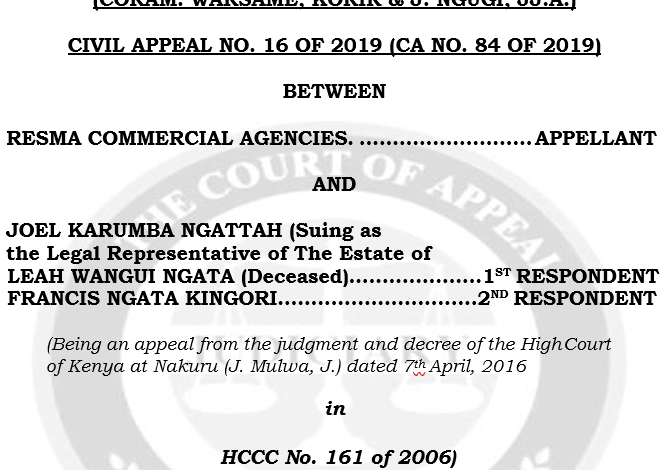
In Nakuru Civil Appeal No. 16 of 2019 (formerly CA No. 84 of 2019), a husband quietly sold the family home to a neighbour while his wife and children still lived in it. When eviction followed, the wife ran to court insisting the property was matrimonial and therefore could not be sold without her consent. The High Court agreed and nullified the sale.
But the Court of Appeal took a sharper, colder look.
The majority bench asked a blunt question: What exactly did the wife contribute to acquiring the home?
In a decision now reverberating across Kenya, the Court held that simply living in a house—no matter how long, how lovingly, or how sacrificially—does not create ownership. A matrimonial home does not magically become joint property because it shelters a family. Marriage and longevity are not proof of entitlement.
The law, the judges said, requires evidence of contribution. Not emotion. Not sacrifice. Not presence. Contribution must be shown—directly or indirectly—through documents, payments, or credible proof of participation in acquiring the property.
In this case, the wife could not demonstrate that she paid for the mortgage, construction, or purchase. Without proof, the Court found no trust existed. Without a trust, her consent was not needed. The sale stood. The buyer kept the title. The family lost the home.
What does this mean for Kenyans?
It means thousands of households may be sitting on silent legal time bombs. A spouse can live in a home for 5, 10, even 30 years—and still walk out with nothing if contribution cannot be proven. It also strengthens the hand of purchasers who rely on the title register, even when families are displaced in the process.
This ruling is a national wake-up call.
Love may build a home, but the law demands evidence. If couples don’t document contributions, structure ownership, and plan their affairs with clarity, the courts will not step in to save them later.
In short: emotions can build families, but only paperwork protects them.